Autonomic function testing aboard the ISS using “PNEUMOCARD”
Executive Summary
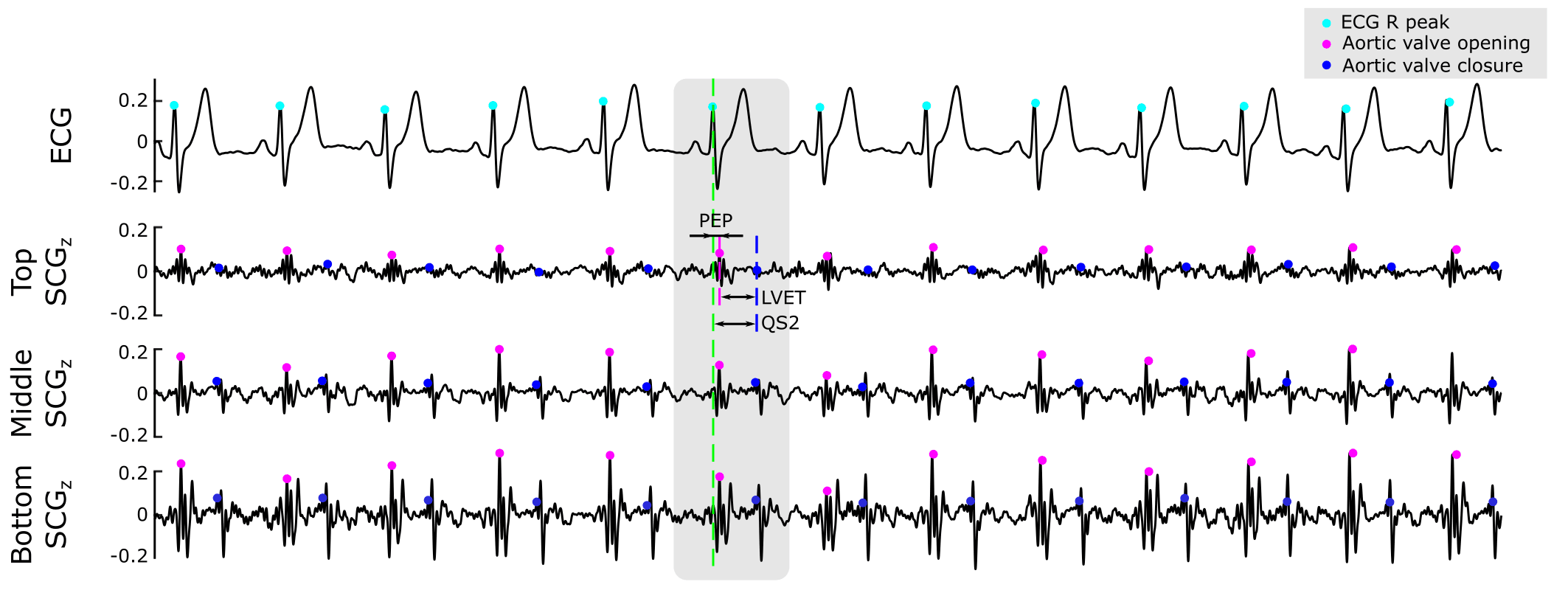
This study investigates the impact of sensor placement on cardiac time interval (CTI) estimations derived from seismocardiography (SCG) signals. Using data from 14 healthy adults, SCG signals were recorded at three sternal locations and analyzed for fiducial points such as aortic valve opening and closure. Results demonstrated significant variability in CTI estimations based on sensor location, with correlation coefficients (R2) between SCG-based and ECG-based heart rate measurements exceeding 0.9798 for most placements. The findings underscore the need for standardized protocols and further validation against gold-standard imaging methods like echocardiography and 4D cardiac computed tomography.
Answer Machine Insights
Q: Does SCG sensor placement affect the accuracy of cardiac time interval estimations?
Yes, the study found significant variability in CTI estimations based on SCG sensor placement.
Results demonstrated that SCG-based CTIs varied with the SCG measurement locations.
Q: How accurate are SCG-based heart rate measurements compared to ECG?
SCG-based heart rate measurements showed high accuracy, with correlation coefficients exceeding 0.9798 for most sensor placements.
The correlation coefficient between HRSCG and HRECG was larger than 0.9798, 0.9883, and 0.8329 for the top, middle, and bottom sensor, respectively.
Key Results
Correlation coefficients (R2) between SCG-based and ECG-based heart rate measurements were 0.9930, 0.9968, and 0.9790 for top, middle, and bottom sternal locations, respectively.
CTI estimations varied significantly based on SCG sensor placement, with the middle and bottom locations showing higher inter-location correlation.
Visual Evidence
Clinical Snapshot
Evidence Rating
Relevance
high Priority