Back to Evidence Hub
Case Study quantifying-and-reducing-motion-artifacts-in-wearable-seismocardiogram-measurements-during-walking-to-assess-left-ventricular-health
2017 Release

Quantifying and Reducing Motion Artifacts in Wearable Seismocardiogram Measurements During Walking to Assess Left Ventricular Health

Executive Summary

This study introduces a framework for reducing motion artifacts in wearable seismocardiogram (SCG) measurements during walking using empirical mode decomposition (EMD). The methodology enables accurate estimation of pre-ejection period (PEP) from SCG signals, validated against impedance cardiogram (ICG) data, with significant improvements in signal-to-noise ratio (SNR). Clinical implications include enabling hemodynamic assessments during activity, such as the 6-minute walk test, which could provide deeper insights into cardiovascular health beyond stationary measurements.

This research shows how wearable chest sensors can measure heart function during walking by reducing motion noise, potentially helping doctors monitor heart health during daily activities.

Answer Machine Insights

Q: How does walking speed affect SCG signal quality?

Walking at higher speeds increases motion artifacts, requiring more heartbeats for accurate PEP estimation.

Walking at higher speeds requires a greater number of heartbeats. Hence, it can be concluded that some measure of intensity of the activity (speed of walking in this instance) can be incorporated into algorithms for better estimation of parameters.

Q: What is the minimum ensemble size for accurate PEP estimation during walking?

On average, 11 heartbeats are required for normal pace walking, increasing with walking speed.

The table shows that, if an RMSE of 3 ms can be tolerated in PEP estimation, then on average 11 heartbeats are required while the person is walking at normal pace.

Key Results

  • EMD-based de-noising reduced warping distance significantly, improving SNR during walking (e.g., dα: M=7.74, SD=5.54 vs. dβ: M=0.84, SD=1.11; p≪0.001).

  • Normalized PEP values from SCG correlated strongly with ICG during normal walking (r=0.86, p<0.01).

Visual Evidence
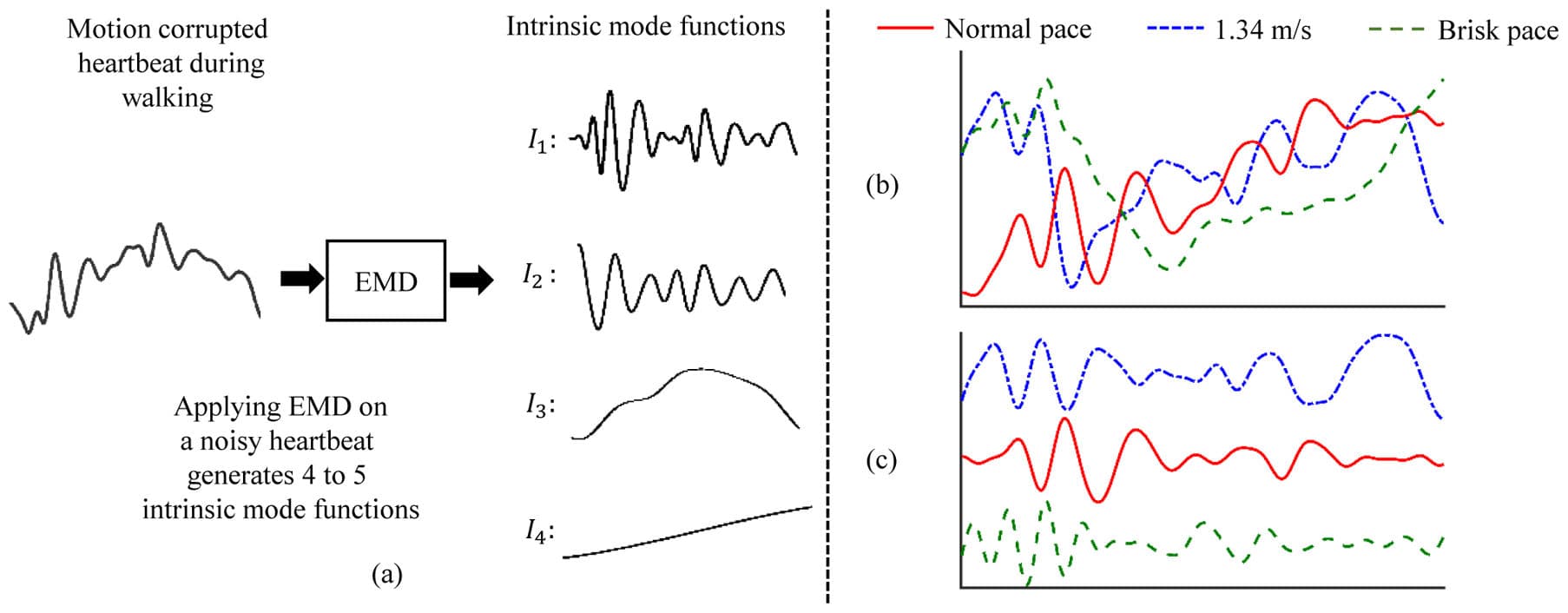
Fig. 3.  (a) De-noising of the D-V heartbeat during walking using EMD algorithm. Four to five imfs  (Im, where m = 1, 2, ...,) were generated after the application of EMD. The first imf (I1) was  chosen as the de-noised D-V heartbeat for feature extraction. (b) Noisy heartbeats for  walking at different speeds. (c) The first imf obtained after application of EMD to the noisy  heartbeats in (b). The basic shape and characteristics of the SCG waveform are reconstructed  accurately.

Fig. 3. (a) De-noising of the D-V heartbeat during walking using EMD algorithm. Four to five imfs (Im, where m = 1, 2, ...,) were generated after the application of EMD. The first imf (I1) was chosen as the de-noised D-V heartbeat for feature extraction. (b) Noisy heartbeats for walking at different speeds. (c) The first imf obtained after application of EMD to the noisy heartbeats in (b). The basic shape and characteristics of the SCG waveform are reconstructed accurately.

Clinical Snapshot

Evidence Rating

Relevance

high Priority

Confidence

Supporting

Relativity Score

4/5
Rigor
4/5
Novelty
5/5
Impact

Semantic Graph Connections

Similar Methodology

Automatic Identification of Systolic Time Intervals in Seismocardiogram

Similar Methodology

Multichannel seismocardiography: an imaging modality for investigating heart vibrations

Similar Methodology

A seismocardiography system and a possibility of its use for diagnosis of internal organs diseases using seismocardiogram information analysis

Similar Methodology

Robustness of Persistence Diagrams to Time-Delay for Seismocardiogram Signal Quality Assessment*

Similar Methodology

A Unified Framework for Quality Indexing and Classification of Seismocardiogram Signals

Similar Methodology

Non-Invasive Wearable Patch Utilizing Seismocardiography for Peri-Operative Use in Surgical Patients

Similar Methodology

Universal Pre-Ejection Period Estimation Using Seismocardiography: Quantifying the Effects of Sensor Placement and Regression Algorithms

Similar Methodology

Toward Wearable Estimation of Tidal Volume via Electrocardiogram and Seismocardiogram Signals

Similar Methodology

A new algorithm for segmentation of cardiac quiescent phases and cardiac time intervals using seismocardiography

Similar Methodology

Wearable Seismocardiography‐Based Assessment of Stroke Volume in Congenital Heart Disease

Similar Methodology

Visualization of the Multichannel Seismocardiogram

Similar Methodology

Cardiac Time Intervals Derived from Electrocardiography and Seismocardiography in Different Patient Groups

Similar Methodology

Porcine Model for Validation of Noninvasive Estimation of Pulmonary Hypertension

Similar Methodology

Application of Acceleration Sensors in Physiological Experiments

Similar Methodology

Multi-site cardiac rhythm monitoring via multi-channel SCG system and exercise-induced physiological analysis

Similar Methodology

Discrete Wavelet Transforms-Based Analysis of Accelerometer Signals for Continuous Human Cardiac Monitoring