Back to Evidence Hub
Case Study toward-wearable-estimation-of-tidal-volume-via-electrocardiogram-and-seismocardiogram-signals
2022 Release

Toward Wearable Estimation of Tidal Volume via Electrocardiogram and Seismocardiogram Signals

Executive Summary

This study introduces a wearable chest patch leveraging ECG and SCG signals to estimate tidal volume (TV) using multimodal demodulation techniques and machine learning. The subject-independent model achieved an RMSE of 181.45 mL and a Pearson correlation coefficient of 0.61, demonstrating improved accuracy compared to prior methods. The findings highlight SCG amplitude modulation (AM) as the most salient feature for TV estimation, paving the way for unobtrusive respiratory monitoring in diverse settings.

This research shows how a wearable chest patch can estimate lung air volume using heart signals and machine learning, offering a step toward easy, continuous respiratory health monitoring.

Answer Machine Insights

Q: What is the most salient feature for tidal volume estimation?

SCG amplitude modulation (AM) features are the most salient for tidal volume estimation.

In Figure 5 a), the SCGy,am, dorsoventral (DV) amplitude modulated component of SCG, feature is the most salient compared to other SCG directions and demodulation techniques.

Q: How does the model perform compared to prior studies?

The model achieves an RMSE of 181.45 mL and r of 0.61, outperforming prior ECG-only methods with RMSE of 235.6 mL and r of 0.26.

The ECG features alone achieve a RMSE of 235.6 mL and r of 0.26 while SCG features achieve 203.6 mL and 0.49, respectively. When adding SCG AM features, the RMSE improves to 181.45 mL and r to 0.61.

Key Results

  • Root-mean-square error (RMSE) of 181.45 mL for tidal volume estimation.

  • Pearson correlation coefficient (r) of 0.61 using a subject-independent model.

Visual Evidence
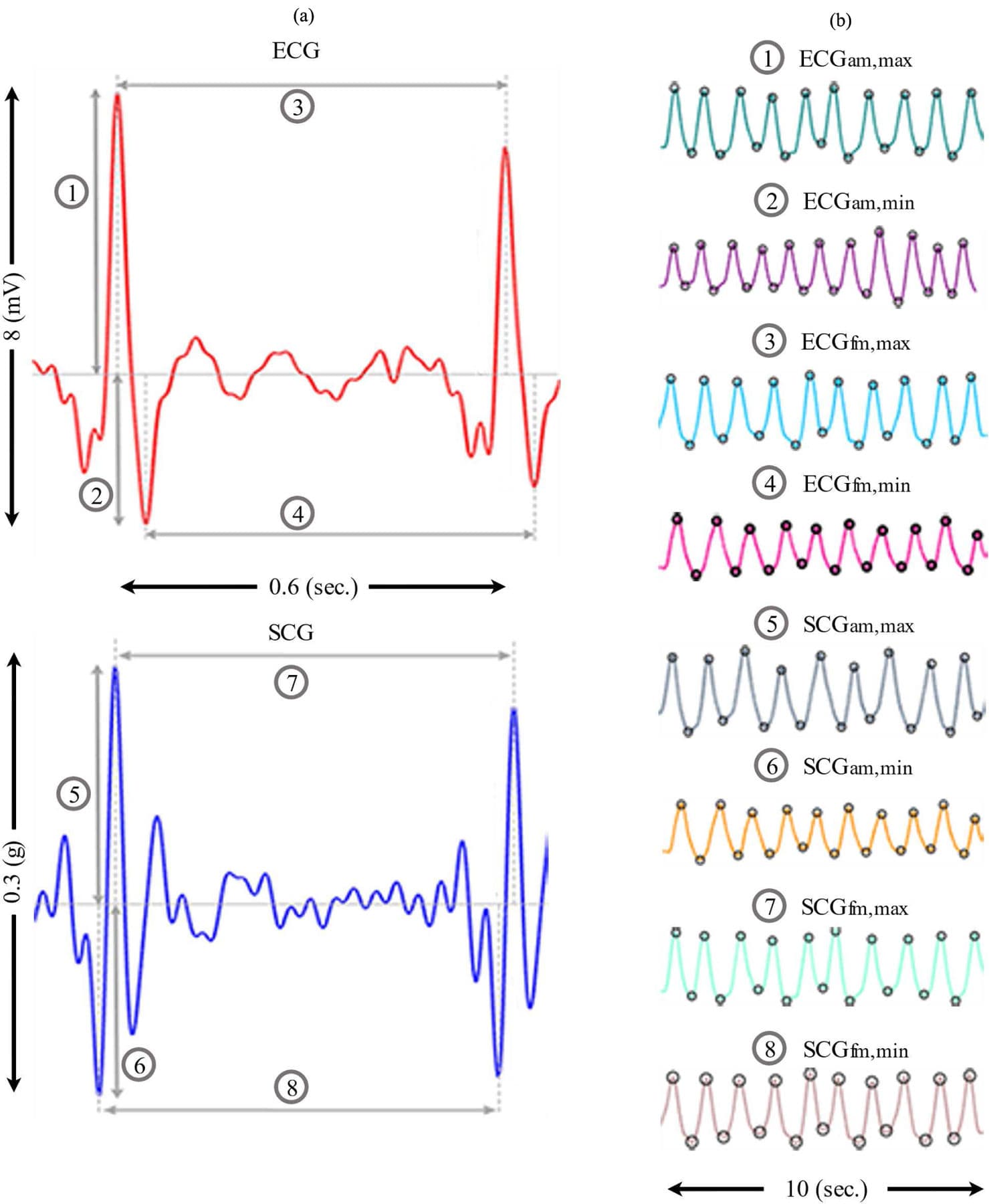
Fig. 3.  a) Description of the extracted respiration features from ECG (top) and SCG (bottom).  Amplitude features are numbered 1, 2 for ECG and 5, 6 for SCG. While frequency features  are numbered 3, 4 for ECG and 7,8 for SCG. b) The corresponding TV is extracted from the  features in a) by detecting peaks and valleys.

Fig. 3. a) Description of the extracted respiration features from ECG (top) and SCG (bottom). Amplitude features are numbered 1, 2 for ECG and 5, 6 for SCG. While frequency features are numbered 3, 4 for ECG and 7,8 for SCG. b) The corresponding TV is extracted from the features in a) by detecting peaks and valleys.

Clinical Snapshot

Evidence Rating

Relevance

high Priority

Confidence

Supporting

Relativity Score

4/5
Rigor
4/5
Novelty
5/5
Impact

Semantic Graph Connections

Similar Methodology

Monitoring of respiration and cardiorespiratory interactions from multichannel seismocardiography signals

Similar Methodology

Estimation of cardiorespiratory fitness in healthy using seismocardiography

Similar Methodology

Accurate and consistent automatic seismocardiogram annotation without concurrent ECG

Similar Methodology

Postural and longitudinal variability in seismocardiographic signals

Similar Methodology

A seismocardiography system and a possibility of its use for diagnosis of internal organs diseases using seismocardiogram information analysis

Similar Methodology

Robustness of Persistence Diagrams to Time-Delay for Seismocardiogram Signal Quality Assessment*

Similar Methodology

A Unified Framework for Quality Indexing and Classification of Seismocardiogram Signals

Similar Methodology

Non-Invasive Wearable Patch Utilizing Seismocardiography for Peri-Operative Use in Surgical Patients

Similar Methodology

Universal Pre-Ejection Period Estimation Using Seismocardiography: Quantifying the Effects of Sensor Placement and Regression Algorithms

Similar Methodology

Quantifying and Reducing Motion Artifacts in Wearable Seismocardiogram Measurements During Walking to Assess Left Ventricular Health

Similar Methodology

A Hidden Markov Model for Seismocardiography

Similar Methodology

High-Accuracy, Unsupervised Annotation of Seismocardiogram Traces for Heart Rate Monitoring

Similar Methodology

A new algorithm for segmentation of cardiac quiescent phases and cardiac time intervals using seismocardiography

Similar Methodology

Combined measurement of ECG, Breathing and Seismocardiograms DataBase (CEBSDB)

Similar Methodology

Machine Learning Based Classification of Myocardial Infarction Conditions Using Smartphone-Derived Seismo- and Gyrocardiography

Similar Methodology

Determining the Respiratory State From a Seismocardiographic Signal--A Machine Learning Approach

Similar Methodology

Visualization of the Multichannel Seismocardiogram

Similar Methodology

Cardiac Time Intervals Derived from Electrocardiography and Seismocardiography in Different Patient Groups

Similar Methodology

Porcine Model for Validation of Noninvasive Estimation of Pulmonary Hypertension

Similar Methodology

Application of Acceleration Sensors in Physiological Experiments

Similar Methodology

Multi-site cardiac rhythm monitoring via multi-channel SCG system and exercise-induced physiological analysis

Similar Methodology

Advanced Fusion and Empirical Mode Decomposition-Based Filtering Methods for Breathing Rate Estimation from Seismocardiogram Signals