Back to Evidence Hub
Case Study automatic-identification-of-systolic-time-intervals-in-seismocardiogram
2016 Release

Automatic Identification of Systolic Time Intervals in Seismocardiogram

Executive Summary

This study presents an automated approach for identifying systolic time intervals (STI) in seismocardiogram (SCG) signals using a sliding template methodology. The method leverages ensemble averaging to suppress noise and improve peak detection accuracy, validated across supine and seated postures with over 5600 heartbeats. Results demonstrate robust performance in noisy conditions, with significant improvements over existing envelope-based methods, suggesting potential for wearable cardiac health monitoring systems.

This research shows how wearable sensors can accurately track heart function by analyzing vibrations from the chest, even in noisy conditions, paving the way for continuous heart health monitoring.

Answer Machine Insights

Q: How does the proposed method compare to existing envelope-based approaches?

The proposed method demonstrated significantly smaller limits of agreement (LoA) in peak detection, indicating higher accuracy and robustness.

The LoA widths of the proposed approach with generalized-15 parameters in supine and seated trials are 16.1 ms and 42.9 ms respectively, which are significantly smaller than the existing approach.

Q: What is the impact of noise on the detection accuracy?

The proposed method maintained high detection accuracy under both pre-filtering and post-filtering Gaussian noise scenarios, outperforming the envelope-based method.

The proposed approach outperforms the envelope-based method, especially in the post-filtering noise scenarios as shown in Fig. 7(b) and (d).

Key Results

  • The proposed method achieved a Bland-Altman limit of agreement (LoA) of 16.1 ms for supine trials and 42.9 ms for seated trials, significantly outperforming the envelope-based method.

  • AC peak detection accuracy remained robust under Gaussian noise scenarios, with minimal degradation even at low signal-to-noise ratios (SNR).

Visual Evidence
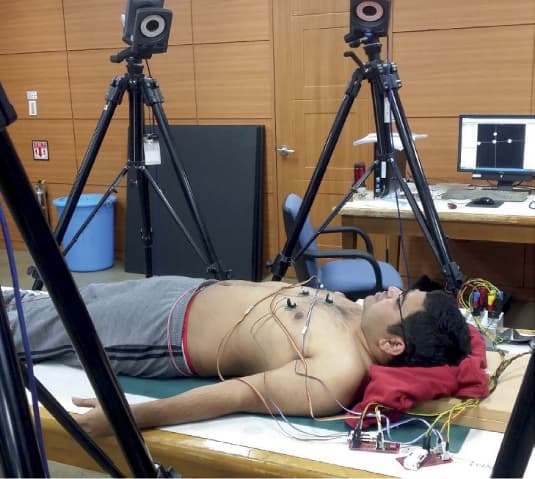
Figure 2.  Experimental Setup - postures and data acquisition. Accelerometer placed at lower sternum was  considered for this study.

Figure 2.  Experimental Setup - postures and data acquisition. Accelerometer placed at lower sternum was considered for this study.

Clinical Snapshot

Evidence Rating

Relevance

high Priority

Confidence

Supporting

Relativity Score

4/5
Rigor
4/5
Novelty
5/5
Impact

Semantic Graph Connections

Similar Methodology

Definition of Fiducial Points in the Normal Seismocardiogram

Similar Methodology

Accurate and consistent automatic seismocardiogram annotation without concurrent ECG

Similar Methodology

Multichannel seismocardiography: an imaging modality for investigating heart vibrations

Similar Methodology

A seismocardiography system and a possibility of its use for diagnosis of internal organs diseases using seismocardiogram information analysis

Similar Methodology

Seismocardiography and echocardiography: the correlation in the systolic complex

Similar Methodology

Quantifying and Reducing Motion Artifacts in Wearable Seismocardiogram Measurements During Walking to Assess Left Ventricular Health

Similar Methodology

A Hidden Markov Model for Seismocardiography

Similar Methodology

A new algorithm for segmentation of cardiac quiescent phases and cardiac time intervals using seismocardiography

Similar Methodology

Novel Wearable Seismocardiography and Machine Learning Algorithms Can Assess Clinical Status of Heart Failure Patients

Similar Methodology

Wearable Seismocardiography‐Based Assessment of Stroke Volume in Congenital Heart Disease

Similar Methodology

Seismocardiograph Monitoring Using SMS Fiber Structure with PDMS Enclosure

Similar Methodology

Visualization of the Multichannel Seismocardiogram

Similar Methodology

Cardiac Time Intervals Derived from Electrocardiography and Seismocardiography in Different Patient Groups

Similar Methodology

Porcine Model for Validation of Noninvasive Estimation of Pulmonary Hypertension

Similar Methodology

Application of Acceleration Sensors in Physiological Experiments

Similar Methodology

Multi-site cardiac rhythm monitoring via multi-channel SCG system and exercise-induced physiological analysis

Similar Methodology

A Cardiac Early Warning System with Multi Channel SCG and ECG Monitoring for Mobile Health

Similar Methodology

High-Resolution Seismocardiogram Acquisition and Analysis System.

Similar Methodology

Three-dimensional apex-seismocardiography